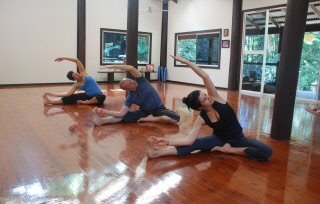
If you’re new to yoga, you might not know what to expect when you walk in the doors of a beginner’s yoga class for the first time. You might not even know how to start in choosing a beginner’s yoga classes to attend. Here’s a “how to” checklist.
1. Nail down your goals and find the right style for you.
Everyone comes to yoga for different reasons. Sometimes these differences are slight, other times they’re vast.
For instance, are you interested in an intense physical workout to throbbing music, or are you on more of a spiritual path towards (quiet) enlightenment? Are you attracted to yoga because of its health benefits, and if so, is it physical or emotional health you are most interested in?
Are you interested in the philosophy and rich traditions of yoga, or are you on the other extreme and wouldn’t be caught dead reciting a mantra?
Whatever your personal needs and proclivities, there’s a yoga for you. If several flavors of yoga are offered in your area, do your research online or in the library to find which style would be the best fit for you.
Once you know what it is you’re looking for, you can set some goals. Call the teacher of the beginner yoga class you’re considering and ask if your expectations are reasonable.
2. Choose a drop-in or series beginner yoga class
A drop-in yoga class allows you to pay-as-you go. There will likely be some turnover week to week as to which students show up for class. The teacher is likely to keep this class on the mild side, because students will be at such differing ability levels.
This may be just what you’re looking for if you just want a taste of yoga but don’t want to buy an expensive package of classes. This may also be a good choice for you if your schedule won’t allow you to attend a class every week. Keep in mind there are significant drawbacks.
One, because the class is ongoing, you will never get to start at “the beginning.” You may be a little lost at first while you learn the culture of the class. Also, drop-in beginner yoga classes tend to be repetitive.
A series yoga class is different in that you buy a set number of classes and each class builds on what you learned in the previous week. A good series class is repetitive only in that there is some review each time, but then the teacher introduces new material.
You can learn much more much faster in a series class, but again there are drawbacks. First, if you miss a class it may be difficult to make up the material that you missed. Also, you will be asked to pay for the whole series up front.
Take a look at your level of commitment, your schedule and your budget and decide whether a drop-in or a series class is better for your needs.
3. Make sure the teacher has adequate training.
Yoga is now a significant contributor to sports injuries. This can be attributed to two things: students pushing themselves too hard for perfection and inadequate training of instructors.
Don’t be shy in asking your potential instructor about their background. There are certifications for teaching “gym yoga” that an instructor can get in a long weekend. A three day training is just enough to make someone dangerous. That’s not to say that some of the people who start with such certifications don’t turn out to be excellent instructors by dedicating themselves to practice and increasing their knowledge over the course of months and years.
There are of course people who teach yoga with no formal certification whatsoever, and though it might be difficult for these teachers to get liability insurance, there’s nothing illegal about it. Keep in mind that yoga is a spiritual tradition thousands of years old, and the idea of giving someone a certificate for learning a few poses and breathing techniques would have been an odd idea indeed even seventy years ago. It is one thing to wake up one morning and decide to teach yoga with little to no experience. It is quite another to teach after living for years under the tutelage of a master yogi who just doesn’t believe in certificates.
As a general rule, seek out yoga teachers with at the very least 200 hours of training. In the United States there’s an organization called the Yoga Alliance that offers a registry of teachers who attended training programs that meet certain standards. Someone can have the Registered Yoga Teacher (RYT) designation from the Yoga Alliance and still be a crummy teacher, but usually RYTs are a safe bet.
4. Look into additional costs of the yoga class.
Sometimes there are additional costs involved in taking a beginner’s yoga class besides the registration fee. You may need to buy your own yoga mat, strap, or other props, for instance. In some classes you may need to buy certain books for study or even special clothing of a certain color.
It is important to know what the related costs are up front so that you and your bank account won’t encounter any surprises later on.
I hope this checklist will help you find a beginner’s yoga class that’s right for you.
Showing posts with label yoga tips. Show all posts
Showing posts with label yoga tips. Show all posts
Sunday, April 12, 2009

Friday, April 10, 2009
Styles of Yoga for Beginners
Are you looking for an activity that will allow you to steer clear of the stresses in your life, while maintaining the balance and harmony of your body? This is what yoga is all about. In layman's term, yoga is the discipline of stretching and toning your body through breathing techniques, exercises, posture, diet and relaxation techniques. Basically, the goal of yoga is to maintain control of your own body and mind.
Read on to find out more about yoga, its different types and yoga tips for beginners by Yoga Classes.
Yoga for Beginners, Anyone?
If you see a room full of individuals undergoing advanced yoga classes, you might be intimidated at the complicated poses that they make. This is the reason why there is a different set of poses and exercises which are meant for beginners in yoga.
Basically, a beginner's class in yoga will give you a preview of what the discipline is all about. Probably the only thing that you need is a yoga mat and a willingness to learn about the yoga basics.
Different Strokes for Different Folks: 11 Types of Yoga
After graduating from beginner's yoga, there are different paths that you can pursue. Take a look at the 9 different types of yoga that you can consider studying:
1.Ananda - this type of yoga focuses more on meditation techniques.
2.Anusara - the thrust of the yogic exercises involved in Anusara Yoga is oriented towards the heart.
3.Ashtanga - also known as the power of yoga, Ashtanga follows a series of steps and poses which are vigorous and quite athletic.
4.Bikram - this is also known as Fire Yoga or Hot Yoga, a style of yoga developed by Bikram Choudhury which practiced in a heated and humidified room.
5.Integral Yoga - this type of yoga focuses on the healing power of relaxation.
6.Iyngar - the center of study in this type of yoga is symmetry and alignment.
7.Kripalu - this style of yogic exercises deals with the 'yoga of consciousness'.
8.Kundalini - the focus of this style of yoga is to awaken one's energy.
9.Sivanada - if you want to live a healthier lifestyle, this is the style of yoga to go for.
10.Tantra - ideal for couples, this type of yoga deals with sensual spirituality.
11.Viniyoga - focuses on a gentle flow of the energies within the mind, body and spirit.
No matter which type of yogic exercises it is that you will go for, they all seek to create that delicate balance between the body, the mind and the spirit.
Subscribe to:
Posts (Atom)